

Participant Information Package
Welcome to AUA Summit 2026
Dear Esteemed Delegates,
Welcome to the AUA Summit 2026, hosted by Nazarbayev University — the leading university in Central Asia, in the vibrant heart of Astana, Kazakhstan. We are delighted to welcome distinguished representatives of AUA member universities and partners to this important gathering dedicated to strengthening collaboration and shaping the future of higher education in Asia. This Information Package has been prepared to support your visit and provide useful guidance throughout your stay in Astana. Inside, you will find key logistical information, program details, and practical recommendations to ensure a smooth and comfortable Summit experience. We sincerely hope that your time at the AUA Summit 2026 will be productive, engaging, and enjoyable, and that you will also have the opportunity to experience the hospitality, culture, and spirit of Kazakhstan.
- Wi-Fi on campusAll campus reading rooms, dormitories, and classrooms have access to free Wi-Fi.
Network: NUGuest
Password: No password required
112 is the unified emergency dispatch service number in Kazakhstan. The service operates 24 hours a day, 7 days a week and is available for reporting emergencies or situations requiring urgent assistance.
You should call 112 only in cases involving a real threat to life, health, property, public safety, or the environment.
In addition to 112, Kazakhstan also maintains direct emergency service numbers:
101 — Fire and Rescue Service
102 — Police
103 — Ambulance / Medical Emergency
104 — Gas Emergency Service
In some situations, it may be more appropriate to contact the relevant emergency service directly. Calls to emergency services are free of charge and can generally be made from both loca

Higher education institutions are undergoing significant transformation driven by rapid technological advancement, changing labor market demands, and evolving societal expectations. Universities are increasingly expected to operate as agile, industry-connected, and strategically governed institutions that produce future-ready graduates, impactful research, and sustainable societal value.
In response to these shifts, the Asian Universities Alliance Presidents Forum 2026 will focus on two critical dimensions shaping the future of higher education:
- Reimagining university governance models for institutional resilience and innovation
- Strengthening university–industry collaboration in education
- Explore effective models of university–industry engagement in education and training
- Examine emerging governance models for future universities
- Identify challenges and opportunities in transforming higher education institutions
- Foster strategic collaboration among AUA member universities
- Share best practices that enhance institutional impact, sustainability, and responsiveness
Universities are facing increasing pressure to become more agile, accountable, and responsive to global challenges. Traditional governance structures are being reconsidered to support digital transformation, innovation, financial sustainability, and institutional resilience.
This session will examine emerging governance models that enable universities to adapt to changing environments while maintaining academic excellence, autonomy, and stakeholder trust. The discussion will focus on leadership structures, decision-making processes, institutional flexibility, and governance innovation.
Key Discussion Themes:
- Emerging governance models in higher education
- Institutional agility and strategic decision-making
- Governance for digital transformation and innovation
- Balancing academic autonomy and accountability
- Stakeholder engagement in university governance
- Leadership structures for future universities
1. How are universities transforming governance structures to enhance institutional agility and effectiveness?
2. What governance practices support innovation, digital transformation, and strategic growth?
3. How can universities balance autonomy, accountability, and stakeholder expectations?
4. What leadership models best support future-ready universities?
5. How can governance frameworks strengthen institutional resilience and sustainability?
SESSION 2: Role of Industry in University Education — Practice and Challenges
The alignment of university education with industry needs has become essential in preparing graduates for a rapidly changing workforce. Strong university–industry collaboration enhances curriculum relevance, supports experiential learning, and facilitates knowledge transfer and innovation.
This session will explore successful models of collaboration, mechanisms for integrating industry engagement into academic programs, and strategies for building sustainable partnerships. University leaders will share their experiences in bridging the
gap between academic preparation and labor market demands while addressing potential risks and operational challenges.
Key Discussion Themes:
- Models of university–industry collaboration in teaching and learning
- Integration of internships, co-op programs, and work-based learning
- Industry participation in curriculum development and program design
- Skills development and future workforce readiness
- Benefits and challenges of university–industry partnerships
- Managing risks, expectations, and long-term sustainability of partnerships
1. How does your university collaborate with industry to enhance educational quality and graduate employability?
2. What successful models or initiatives demonstrate effective university–industry engagement?
3. How are industry partnerships integrated into academic programs and curriculum design?
4. What challenges arise in university–industry collaboration, and how can institutions address them?
5. How can universities ensure long-term, mutually beneficial partnerships with industry stakeholders?
- Prof. Waqar Ahmad, President, Nazarbayev University
- Prof. Mohsen Sherif, Provost, United Arab Emirates University
Prof. Mohsen Sherif, Provost, United Arab Emirates University
Speakers:
Prof. Waqar Ahmad, President, Nazarbayev University
Prof. Wilert Puriwat, President, Chulalongkorn University
Prof. Kaori Hayashi, Executive Vice President, The University of Tokyo
Prof. Son Bao Pham, Vice President, Vietnam National University, Hanoi
Prof. Ayesha Al Dhaheri, Advisor, United Arab Emirates University
Speakers:
Prof. Bin Yang, Vice Chancellor, Tsinghua University Council
Prof. Rehan Sadiq, Provost, Nazarbayev University
Prof. Jimmy Fung, Associate Provost (Teaching & Learning), The Hong Kong University of Science and Technology
Prof. Booyuel Kim, Deputy Vice President of Global Affairs, Seoul National University
- Generate strategic insights on industry engagement in university education
- Identify innovative governance approaches for future universities
- Strengthen collaboration among AUA member institutions
- Provide recommendations to support higher education transformation
Senior Health Services Manager
Working Hours 08:00 – 20:00
Lunch Break 12:30 – 13:30
Airport transportation for AUA Summit 2026 delegates will be arranged by Nazarbayev University.
- Representatives of the organizing team will meet participants at Nursultan Nazarbayev International Airport (NQZ) according to the submitted flight information and assist with transfer to the hotel.
- Detailed information regarding pickup times, meeting points, and contact persons will be shared with delegates prior to arrival.
- Transportation between the airport and the hotel will be provided once for both arrival and departure.
- The transportation schedule will primarily be arranged according to the arrival and departure times of Delegation Heads.
- Delegates are kindly requested to carefully review and confirm their flight information in advance to ensure smooth transportation arrangements.
Yandex Go is the most widely used ride-hailing application in Kazakhstan.
- Open the application after collecting your luggage
- Enter your destination and select your preferred ride category
- The application will display the fixed fare, driver details, and route information
Participants are advised to:
- Confirm the fare before departure
- Request a receipt when possible
- Use only official taxi services available inside the terminal
The hotel is part of Abu Dhabi Plaza — one of the largest mixed-use developments in Central Asia — which includes restaurants, shopping facilities, office spaces, and leisure amenities.
Additional information: https://www.marriott.com/
Coffee breaks, networking lunches, the welcome dinner, and the closing reception will be provided by the organizing committee throughout the Summit.
Please refer to the official Summit Program for detailed timing and venue information.
Today, Astana is home to more than one million residents and is recognized for its dynamic atmosphere, rapidly developing infrastructure, and concentration of young professionals and students.
Participants are advised to bring both light daytime clothing and a light jacket for cooler evenings.
English is widely used at Nazarbayev University and will serve as the primary
working language of the Summit.
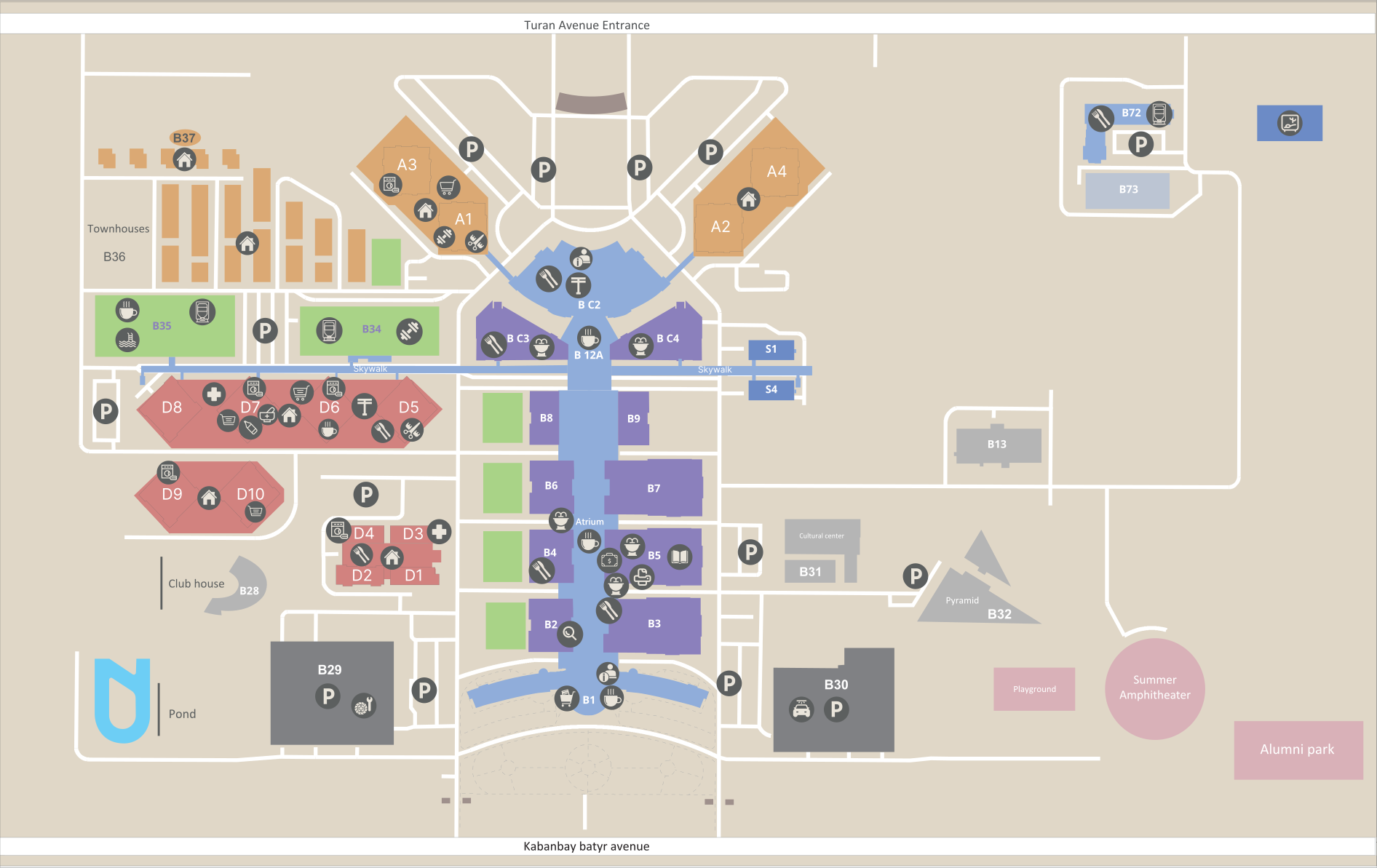



- Wi-Fi on campusAll campus reading rooms, dormitories, and classrooms have access to free Wi-Fi.
Network: NUGuest
Password: No password required
Astana, Kazakhstan